Deciding whether to build a family home or a multi-story office tower might sound like apples-versus-oranges, but the differences go much deeper than scale. This article unpacks the practical, legal, financial, and human distinctions between commercial and residential projects—so owners, designers, contractors, and curious readers can see how choices on site, code, and contract ripple through a project from first sketch to the day people move in.
High-level distinctions: purpose, users, and lifecycle
At its simplest, residential construction creates places people live; commercial construction creates places people work, shop, heal, or gather. That difference in purpose drives nearly everything else: occupancy loads, mechanical needs, circulation patterns, and durability expectations are designed around how the building will be used and by how many people.
Residential projects often prioritize privacy, comfort, and aesthetic variety. Commercial projects prioritize efficiency, flexibility, and code-driven safety for larger, denser populations. Those priorities influence choices from window placement to the type of HVAC system and how often elevators are required.
Because use and lifecycle expectations diverge, so do maintenance strategies and long-term budgeting. A single-family house may be planned for decades with periodic updates, while a retail center or hospital anticipates continuous maintenance, tenant turnover, and systems that can handle heavy, uninterrupted use.
Typical project types and stakeholders
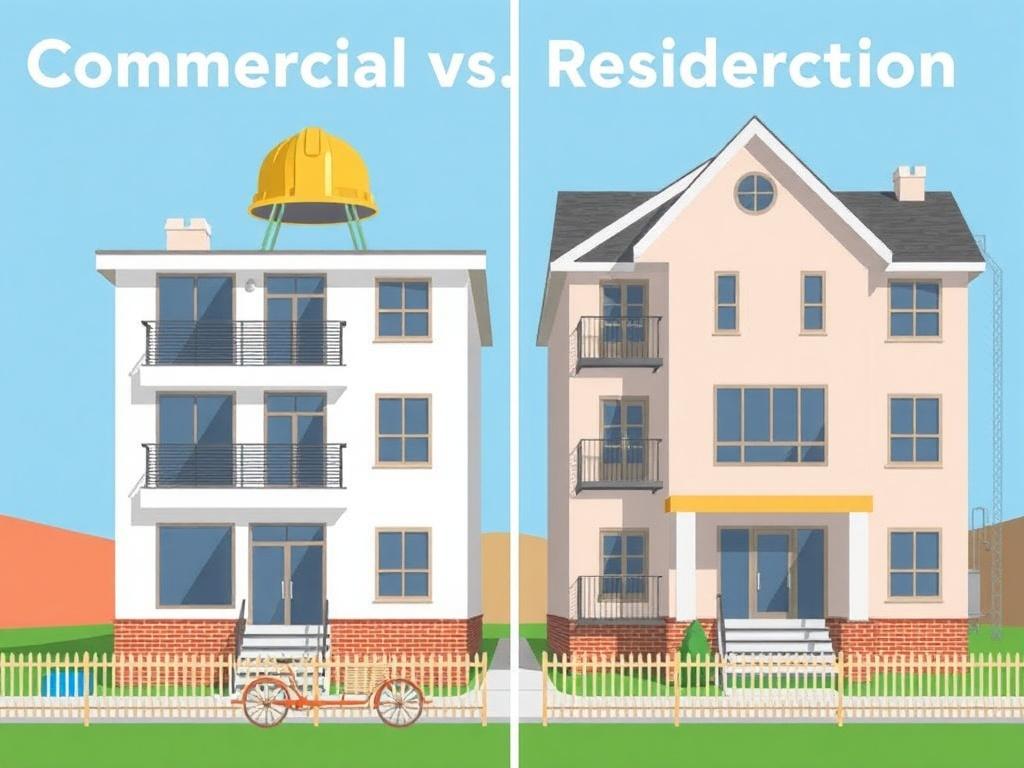
Residential projects range from single-family homes and duplexes to large multifamily buildings and condominiums. Commercial projects include offices, retail centers, hotels, warehouses, schools, hospitals, and mixed-use developments where residential and commercial functions coexist.
Stakeholders also differ. Residential projects often involve the homeowner, an architect or designer, and a general contractor. On commercial jobs, the roster grows: developers, property managers, investors, corporate tenants, civil engineers, specialty consultants, and often a facilities team focused on long-term operations.
Understanding who holds decision-making power—and at what phases—is critical. A homeowner may decide finishes and layout personally, while in commercial work, tenant requirements, lease structures, and investor returns can shape design and construction choices more than individual taste.
Quick comparison table
| Aspect | Residential | Commercial |
|---|---|---|
| Primary use | Living spaces, private occupancy | Work, retail, hospitality, institutional |
| Scale | Small to medium; localized systems | Medium to large; centralized systems |
| Codes & regulations | Residential building codes; local zoning | Commercial building codes, ADA, fire, occupancy-specific rules |
| Financing | Mortgages, owner-funded | Commercial loans, investors, leases |
| Stakeholders | Homeowner, designer, GC | Developer, tenants, multiple consultants |
Project scale and complexity
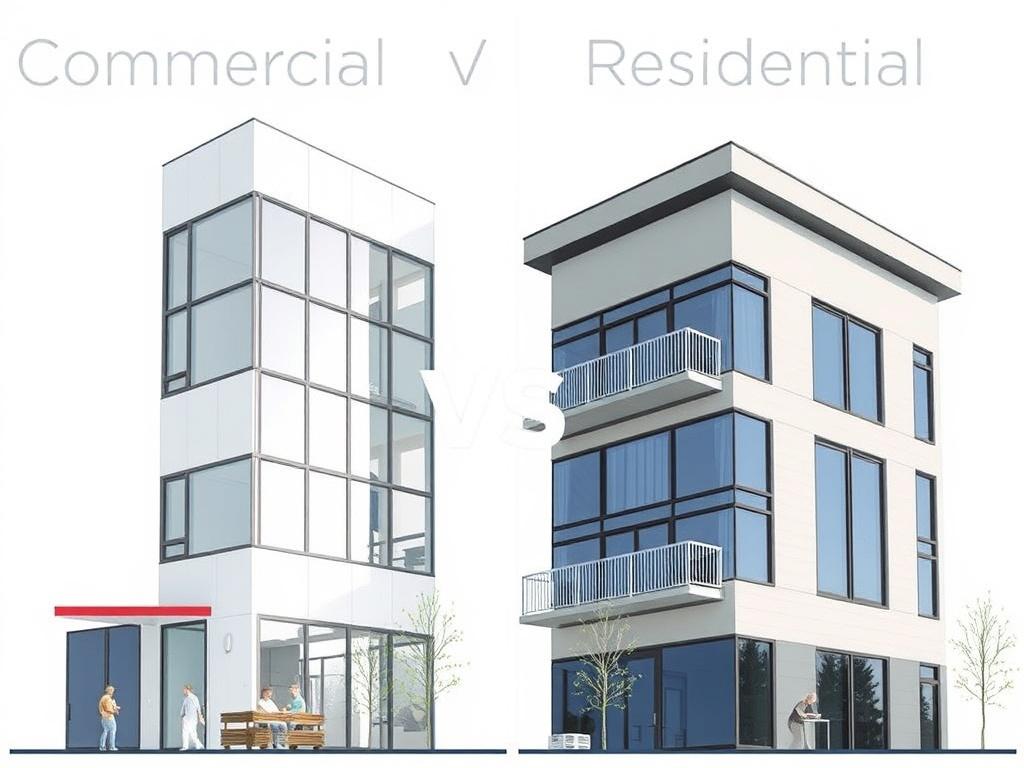
Scale matters. A small home remodel or new house usually involves fewer trades, shorter timelines, and a lower number of subcontractors. Commercial projects often require dozens of specialty subcontractors and complex coordination between disciplines such as structural steel, curtainwall, high-voltage electrical, and fire protection.
Complexity grows with required redundancies and system interdependence. In a commercial building a failure of a single component—like a chilled water pump—can affect an entire floor or tenant, so designers add redundancy, monitoring, and controls that residential systems rarely need.
Large projects also demand more project controls. Scheduling, procurement of long-lead items, quality assurance, and testing become intensive activities. I’ve overseen an office fit-out where a single delayed mechanical package held the project for weeks—an outcome far less likely on a modest residential job.
Codes, permitting, and inspections
Both project types must meet codes and receive permits, but the layers and scope differ. Residential work typically follows the International Residential Code (IRC) or local equivalents; commercial work follows the International Building Code (IBC) and a suite of specialized regulations for accessibility, fire safety, and occupancies.
Commercial projects frequently trigger additional permitting paths: environmental impact assessments, fire marshals’ approvals, signage permits, and enterprise-level accessibility reviews. Inspections are more numerous and often more technical, involving specialists for sprinkler systems, elevators, and energy compliance.
Permitting timelines can be a major driver of project schedules. Smaller residential permits might be secured in weeks, while a commercial development can spend months, even years, in entitlement and zoning review. It’s a common cause of schedule slippage and budget pressure for developers.
Design and architectural considerations
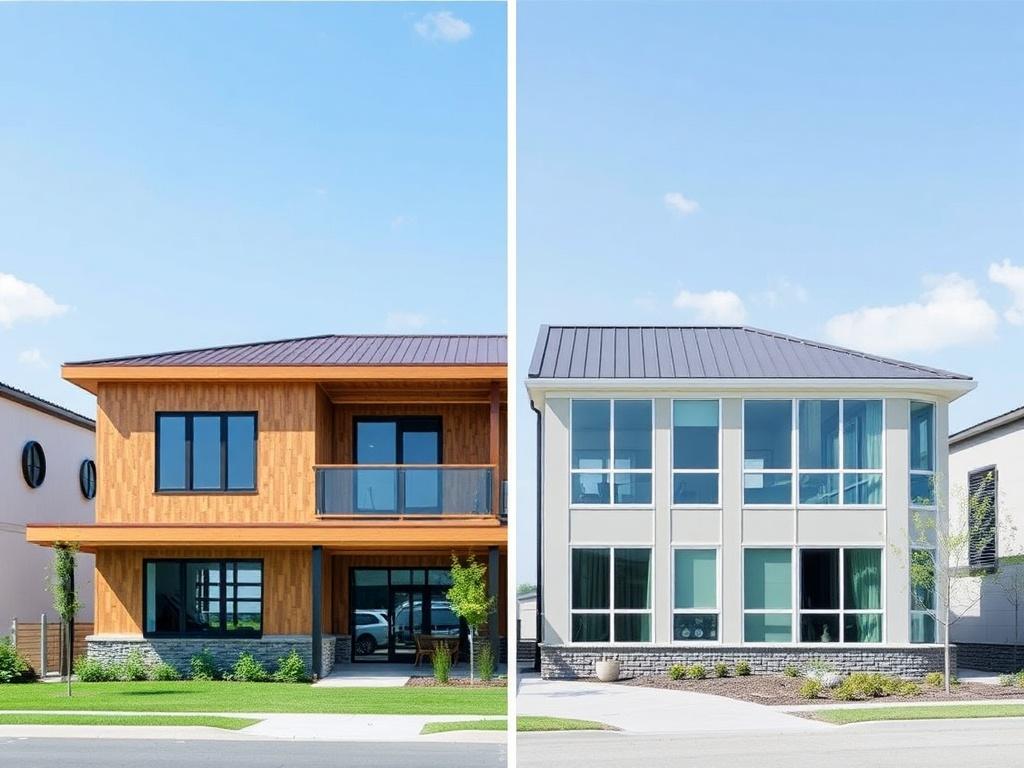
Residential design focuses on human scale, circulation that supports daily life, and design cues that respond to neighborhood context. Architects tailor each home to its site, orientation, and owner preferences—often allowing more freedom and individuality than commercial projects allow.
Commercial architecture must reconcile brand identity, operational efficiency, and code-driven egress and accessibility. A retail tenant will demand clear pathways, merchandising sightlines, and loading access; an office will need efficient core placement for elevators, restrooms, and mechanical stacks.
Another distinction is flexibility. Commercial spaces are commonly designed for tenant fit-out and reconfiguration; column spacing, ceiling heights, and MEP distribution are optimized to allow multiple tenant layouts over the building’s life. Residential spaces are usually more fixed in plan and finishes.
Structural systems and materials
Residential buildings often rely on wood framing for single-family homes and light-gauge steel or wood for low-rise multifamily. These materials are cost-effective, quickly installed, and suitable for moderate loads and spans. Foundations are sized for localized loads, and roof systems are simpler.
Commercial structures frequently use concrete and structural steel to achieve long spans, higher load capacities, and open-plan floor plates. Curtain walls, heavy masonry, and complex roofing assemblies are common, which increases the need for precise engineering and coordination between the structural frame and exterior envelope.
Material selection in commercial construction also leans toward durability and low-maintenance finishes, since operating costs and replacement disruption have high business impacts. In contrast, residential choices often balance aesthetics and budget, with owners accepting more frequent cosmetic updates.
Mechanical, electrical, and plumbing differences
MEP systems are a major dividing line. Residential units typically have decentralized systems: individual furnaces, rooftop units for apartments, or split HVAC systems for houses. These installations are smaller, simpler, and usually serve one dwelling unit or a small cluster.
Commercial projects use centralized systems—chilled water plants, boilers, large rooftop units, and building automation systems (BAS) for monitoring and control. The complexity of ductwork, distribution, and controls requires mechanical design that anticipates energy loads, redundancy, and maintenance access.
Electrical design diverges too. A residential panel might be 100–200 amps per unit; commercial buildings require three-phase service, backup power solutions, and sophisticated lighting controls. Plumbing in commercial buildings must address higher water demand, multiple fixtures, and often graywater or medical gas systems for specialized uses.
Life safety, accessibility, and building services
Life safety is more burdensome in commercial work because of higher occupancies and varied uses. Fire protection systems—sprinklers, fire alarms, smoke control, and dedicated fire-rated assemblies—are more extensive. Egress planning is critical to ensure safe evacuation of large numbers of people.
Accessibility regulations like the Americans with Disabilities Act (ADA) have heavier impacts on commercial designs. Public entrances, restrooms, signage, elevators, and circulation paths must meet strict standards that influence layout early in design rather than as afterthoughts.
Building services such as security systems, access control, CCTV, and large-scale waste management are also typical in commercial projects. These systems require space—electrical closets, server rooms, and service corridors—and ongoing operational staffing that residential projects rarely include.
Construction methods, site logistics, and staging
Construction on residential projects is often linear and localized: foundation, framing, enclosure, then finishes. Smaller sites allow simpler staging, limited crane use, and less complex traffic management. Subcontractor crews are typically smaller and specialized mainly in trades like carpentry, plumbing, and electrical.
Commercial construction usually happens on congested sites with heavy staging needs, cranes, hoists, and material just-in-time delivery. Logistics plans handle large deliveries, lane closures, and site security. Safety programs are more rigorous because of the larger workforce and heavier equipment.
Phasing is another difference. Commercial jobs frequently require phased occupancy or tenant coordination, where parts of the building are completed and turned over while work continues elsewhere. That requires careful sequencing and robust temporary protection measures to prevent dust and disruption to occupied areas.
Financing, cost estimating, and budgets
Residential financing tends to be straightforward: mortgages, construction loans, or owner equity. Cost estimating for houses leans on per-square-foot heuristics adjusted for finishes and site conditions. The owner often controls spending decisions in real time, trading scope for quality.
Commercial financing is more layered: developer equity, institutional loans, tax credits, or investor capital. Budgets must account for longer entitlement timelines, higher soft costs like design and permitting, and lease-up periods where the building is not yet producing income.
Estimating commercial costs requires detailed unit-rate pricing, market knowledge of labor and material availability, and allowances for escalation. Value engineering is common as developers balance tenant expectations against projected returns, and contingency management becomes a strategic tool.
Contracts, procurement methods, and risk allocation
Contract forms differ between sectors. Residential projects often use simple fixed-price agreements or time-and-materials contracts. The owner-direct relationship can make decisions faster, but it also concentrates risk with the homeowner if poor contracting practices are used.
Commercial work commonly uses a variety of procurement strategies: design-bid-build, design-build, construction manager at risk (CMAR), and integrated project delivery (IPD). Each allocates risk, schedule control, and cost responsibility differently and is chosen based on project complexity and owner preferences.
Insurance, performance bonds, and warranties are more prevalent and higher dollar-value in commercial contracts. Lenders and investors usually insist on these protections, which adds to the administrative overhead but reduces exposure for stakeholders across the project lifecycle.
Workforce, trades, and scheduling
Residential crews are often smaller and more generalized. A residential carpenter may handle framing, finish work, and some cabinetry installation. That flexibility helps keep home projects nimble and cost-effective when the trades are available.
Commercial projects deploy specialized trades—steel erectors, curtainwall installers, large-scale concrete crews, and HVAC technicians with industrial-level experience. Scheduling these teams efficiently requires a higher degree of coordination, often driven by critical-path method scheduling and sophisticated project management tools.
Labor availability and union agreements can also shape commercial projects. Union labor or prevailing wage requirements on public commercial projects change cost structures and bidding dynamics in a way that typically does not affect private homebuilding as much.
Sustainability, certifications, and life-cycle considerations
Sustainability trends are reshaping both sectors, but commercial projects more often pursue formal certifications like LEED, WELL, or BREEAM because of tenant demand, corporate responsibility, or marketing value. These certifications demand integrated design approaches and can increase upfront costs while lowering operational expenses.
Residential green building is increasingly common too—high-performance envelopes, energy-efficient systems, and water-saving fixtures are desirable for homeowners. However, formal certification for homes is less uniformly pursued unless market conditions or incentives make it advantageous.
Life-cycle thinking also separates the sectors. Commercial owners usually perform life-cycle cost analysis to justify more expensive, durable materials that reduce maintenance and downtime. Homeowners, by contrast, may focus on initial cost and comfort, accepting more frequent renovations over time.
Maintenance, operations, and handover
Handover in commercial projects is a structured process: warranties, as-built drawings, operation and maintenance manuals, and training for facilities staff are standard. Owners expect clear documentation because ongoing operations affect revenue and tenant satisfaction.
Residential handover is simpler; homeowners often receive a set of manuals and a walkthrough with the contractor but may not need a formal operations team. Still, good documentation and a reliable warranty can save a homeowner months of hassle after move-in.
In commercial buildings the owner or property manager often budgets for a dedicated maintenance staff and remote monitoring systems. Predictive maintenance and preventive schedules are part of the asset management strategy, reducing costly emergency repairs and preserving building value.
Real-world examples and personal experiences
Early in my construction career I worked on a 12-unit condominium where the biggest challenge was coordinating finish selections with multiple owners. Simple decisions—tile, paint, and lighting—became complex because each unit owner wanted unique finishes, which forced the contractor to manage multiple purchase orders and extended lead times.
Contrast that with a commercial office renovation I managed later: the client wanted a single open-plan floor and standardized systems to attract tenants. The project demanded a detailed mechanical upgrade, a new sprinkler main, and a tenant improvement package that allowed for multiple lease configurations. Each change had budgetary and code implications, requiring tight coordination with the fire marshal and building department.
These two projects taught me that construction is as much about people and process as it is about materials. Residential projects require sensitivity to personal preferences and timelines tied to family life. Commercial projects require systems thinking, anticipating future users, and aligning design with business needs and regulatory frameworks.
How to choose the right contractor and key advice for owners
Selecting a contractor is crucial regardless of sector, but the criteria shift. For residential work, look for local references, a clear warranty, and a contractor willing to walk you through trade-offs for finishes and systems. Personality and communication often matter as much as price on a home project.
For commercial projects seek contractors with relevant project experience, strong safety records, and the capacity to manage complex subcontractor ecosystems. Verify bonds, insurance, financial health, and the ability to provide references for similar-scale projects. Consider a contractor who offers in-house project controls or a seasoned construction manager.
Across both sectors, insist on clear scopes, milestones, and a well-defined change order process. Poorly documented changes are the most predictable source of disputes and cost overruns. Finally, plan for contingencies—site surprises, permit delays, and market-driven material price swings are part of construction life.
Understanding the contrasts between commercial and residential construction will help teams choose appropriate procurement methods, design strategies, and operational plans. Whether you’re building a backyard home or a multi-tenant office building, recognizing how purpose, code, systems, and stakeholders differ keeps decisions aligned with the project’s long-term goals.
Every project has its own rhythm. Learn that rhythm early, assemble the right team, and you’ll make choices that keep the job on schedule, on budget, and built to last.