
Most builders talk about blueprints, budgets, and finishes, but the ground beneath a site quietly decides whether a project will be straightforward or a saga of change orders and headaches.
Understanding The Importance of Soil Testing Before Construction is not an optional step for responsible owners and engineers; it’s the investigative foundation that turns guesswork into predictable outcomes.
What a geotechnical investigation actually is
A geotechnical investigation is a structured program of field and laboratory tests designed to reveal the physical and mechanical properties of subsurface materials. It answers questions about bearing capacity, compressibility, groundwater conditions, and the presence of contaminants that affect design and construction methods.
Engineers use the investigation to recommend foundations, earthworks, and drainage, and to identify risks such as expansive clays, collapsible soils, or potential for liquefaction. Without these data, designers are forced to rely on assumptions or overly conservative solutions that inflate costs.
The investigation typically begins with a review of site history and existing data, followed by a field program tailored to the project scale and complexity. The results feed directly into structural, civil, and environmental design decisions, so getting the scope right at the start is essential.
Common soil tests and what they reveal
Soil testing combines straightforward field observations with laboratory analyses to create a complete picture of subsurface conditions. Each test has a specific role: some measure strength, others measure compressibility or permeability, and some detect contaminants that trigger environmental controls.
Below is a concise table mapping common tests to their main purposes and typical sampling methods. This is not exhaustive, but it highlights the tools geotechnical engineers reach for most frequently.
| Test | Primary purpose | Typical sample method |
|---|---|---|
| Standard Penetration Test (SPT) | Estimate relative density and stratigraphy; input for bearing capacity | Split-spoon sampling during boreholes |
| Cone Penetration Test (CPT) | Continuous profiling of tip resistance and sleeve friction; fast stratigraphy | Direct push cone sounding |
| Atterberg limits | Classify fine-grained soils by plasticity and shrink-swell potential | Undisturbed or remolded lab samples |
| Grain size analysis | Determine particle size distribution and classification | Lab sieving and hydrometer tests |
| Consolidation test | Measure compressibility and time-rate of settlement | Oedometer testing on undisturbed samples |
| Triaxial/shear tests | Determine shear strength parameters for stability and bearing calculations | Undisturbed samples tested under controlled stresses |
| Proctor compaction | Establish optimum moisture content and maximum dry density for fills | Lab compaction on remolded samples |
Interpreting these test results is as important as obtaining them; the raw numbers must be translated into design parameters like allowable bearing pressure and expected settlement. That interpretation is where field observations, local experience, and judgment come together to produce practical recommendations.
Field investigation methods and how they’re chosen
Field methods vary by site and project type, ranging from simple test pits to advanced geophysical surveys. The selection depends on the thickness of soils of interest, groundwater conditions, the presence of utilities, and whether continuous profiling or discrete samples are needed.
Standard Penetration Tests (SPT) are widely used because they provide both a sampler and a measure of relative density, but they are discontinuous. Cone Penetration Tests (CPT) provide continuous data and are faster, which makes them preferable for large sites with layered deposits.
Test pits and boreholes allow visual logging and sampling; they reveal stratigraphy and often uncover surprises like buried fill or concealed groundwater seeps. Geophysical techniques—seismic refraction, electrical resistivity—can map subsurface features without disturbance and help to target borings more efficiently.
Laboratory testing: turning samples into design data
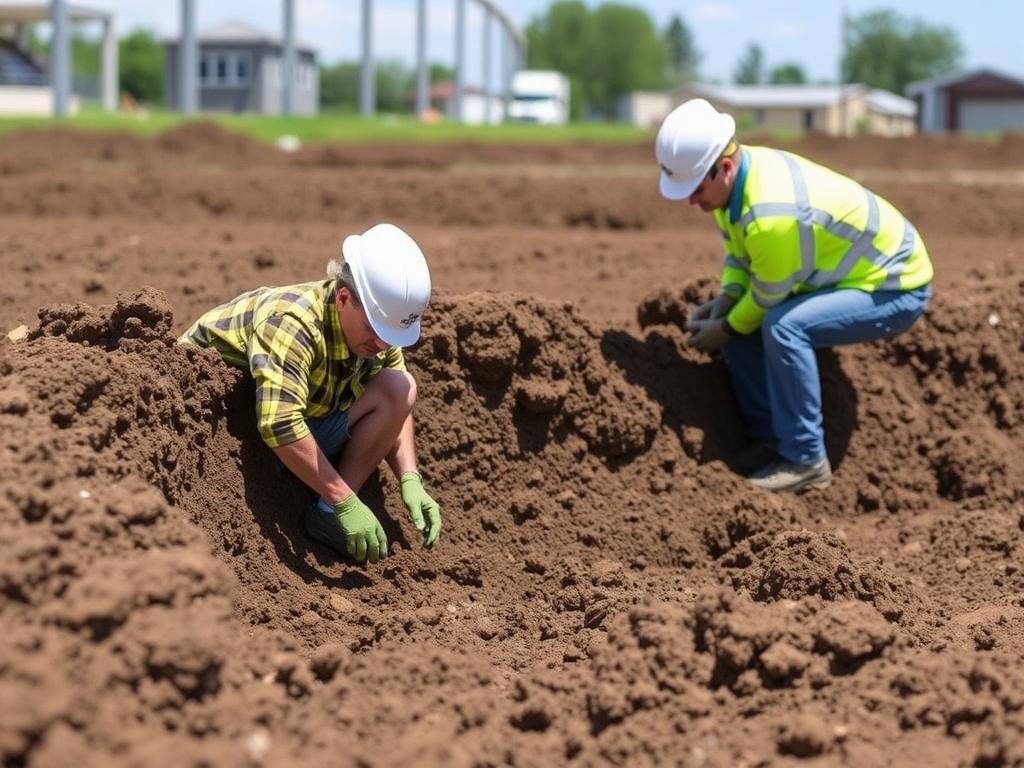
Once samples return to the lab, a sequence of standardized tests converts them into numerical parameters designers trust. Laboratory testing must be controlled and documented, because many parameters are sensitive to sampling disturbance and moisture changes.
Atterberg limits and grain-size analyses feed into soil classification systems such as the Unified Soil Classification System, which guides decisions about suitability for fills or foundation support. Triaxial and direct shear tests quantify strength under specific stress paths and drainage conditions.
Consolidation tests measure how much and how quickly soils compress under load—information that drives decisions about allowable settlement and whether preloading, staged construction, or deep foundations will be required. A thorough lab program reduces surprises during construction.
How soil conditions influence foundation selection
Soil type, strength, and compressibility determine whether a project will use shallow foundations, deep foundations, or specialized ground-improvement techniques. The wrong foundation type can lead to excessive settlement, tilting, or even structural failure.
For uniform, dense granular soils with favorable bearing capacity, shallow footings or slab-on-grade solutions are often economical and simple to build. The design must still account for frost depth, drainage, and potential for heave or shrinkage in certain climates.
When soils are weak, compressible, or highly variable, deep foundations like driven piles, drilled shafts, or augercast piles transfer loads to competent layers or into bedrock. Selecting the right deep foundation system requires careful interpretation of both field logs and lab strengths.
Shallow foundations: benefits and limitations
Shallow foundations are cost-effective when near-surface soils can safely support loads with acceptable settlement. They are quicker to construct and require less equipment, which can be a major advantage on smaller sites.
The trade-off is sensitivity to soil variability, moisture changes, and surface drainage; expansive clays and organic soils are typically unsuitable for shallow support without stabilization. In such cases, soil replacement, lime/cement treatment, or geosynthetics can improve the near-surface profile.
Deep foundations and when they become necessary
Deep foundations become cost-justifiable when loads are high, shallow soils are unreliable, or differential settlement must be minimized. Piles and piers bypass weak strata, transferring loads to dense soils or rock.
Although more expensive upfront, deep foundations can prevent remedial work later. Their design hinges on geotechnical data—without reliable end-bearing or side-shear information from field tests, pile capacity estimates are uncertain and risky.
Settlement: predicting movement and its implications
Settlement is often the most expensive surprise in construction: even small amounts can damage finishes, misalign doors, or crack walls. Predicting settlement requires consolidation tests, an understanding of loading history, and careful modeling of staged construction actions.
Immediate settlement from elastic deformation is modeled differently than long-term consolidation under low-permeability clays, which may take months to years to complete. Differential settlement—uneven movement across a structure—is particularly damaging and must be evaluated in the geotechnical report.
Design strategies to control or accommodate settlement include selecting alternative foundation systems, preloading and surcharge, vertical drains to accelerate consolidation, or designing flexible structural connections that tolerate movement without harm.
Liquid and contaminant hazards: environmental testing and regulation
Soil testing is not only about strength and settlement; it also finds environmental hazards that affect permitting and long-term liability. Brownfields, petroleum hydrocarbons, heavy metals, and volatile organic compounds can halt projects or trigger costly remediation obligations.
Phase I and Phase II Environmental Site Assessments (ESAs) identify potential contamination sources and, when necessary, define contaminant concentrations through targeted sampling. Regulators use these data to obligate remedial action, and lenders often require clearances before financing.
Remediation strategies range from simple removal and backfill to in-situ treatments like bioremediation, stabilization, or thermal methods. Early detection during the geotechnical phase avoids scheduling shocks and aligns cleanup needs with earthwork operations.
Costs, scheduling, and how much investigation is enough
Clients often ask how much soil testing is necessary and what it will cost. There is no one-size-fits-all answer: the required scope depends on project value, risk tolerance, site history, and subsurface complexity. As a rule, spending a small percentage of the construction budget on thorough testing is prudent insurance.
Typical small-building investigations might cost a few thousand dollars; larger commercial or infrastructure projects require more borings, in-situ testing, and extensive lab work that raises the budget into the tens of thousands. These costs must be weighed against the potential for design changes, remedial work, or legal exposure if testing is insufficient.
Timing is another consideration. Geotechnical work fits best early in the design phase so recommendations can be baked into foundation and earthwork plans. Waiting until construction is underway forces on-the-fly fixes that are often expensive and disruptive.
Working with geotechnical engineers: what to expect
Hiring a qualified geotechnical engineer is essential. These professionals design the investigation, supervise fieldwork, interpret lab results, and produce a geotechnical report with practical recommendations. Their expertise bridges soil science and structural requirements.
Expect the report to include site logs, test results, design parameters (bearing capacities, settlement estimates, lateral earth pressures), and construction notes such as groundwater control and recommended excavation methods. A good report will state assumptions and provide options where uncertainty remains.
In my own projects, early collaboration with geotechnical consultants saved unexpected cost overruns. On one suburban school project, a few additional borings located a thin but deep layer of compressible organic silt that, if missed, would have required widespread underpinning mid-construction. The extra investigation cost a small fraction of the avoided remedial expense.
Practical checklist for owners and project managers
To make geotechnical investigation actionable, follow a straightforward sequence that aligns with design milestones. Below is a checklist that helps owners and project managers ensure testing is adequate and timely.
- Review available historical data and maps for previous fill, uses, and groundwater records.
- Define the project loads, footprint, and anticipated subgrade changes with your designer.
- Engage a geotechnical engineer to prepare a site-specific testing plan.
- Schedule fieldwork early and coordinate with utility locators and site access needs.
- Require laboratory testing and a report that includes design parameters and construction recommendations.
- Use the geotechnical report to finalize foundation design, earthwork quantities, and bidding documents.
- Keep a contingency budget for unexpected conditions revealed during construction.
Following these steps reduces the chance that the project will stall for undetected subsurface surprises. Documentation from the investigation also becomes part of the project’s risk-management record for lenders and regulators.
Common misconceptions and pitfalls
One common misconception is that a single borehole proves the whole site. In reality, soils vary laterally and vertically, and the number and spacing of borings should reflect that variability. Under-sampling creates false confidence and often leads to costly midstream discovery.
Another pitfall is treating geotechnical testing as a checkbox exercise. A report that merely lists numbers without clear construction guidance is of limited value. The best reports offer practical notes on how to implement recommendations and how to handle conditions that deviate from expectations.
Finally, ignoring groundwater and drainage is a frequent oversight. Groundwater influences bearing capacity, excavation stability, and long-term performance; it must be addressed early through dewatering plans, drainage details, or waterproofing strategies as part of the geotechnical work.
Innovations and technologies changing soil testing

Technology has improved both speed and resolution of subsurface investigations. Continuous profiling techniques like CPT and high-resolution seismic methods provide more data points per hour than traditional borings, enabling better characterization of complex sites.
Remote sensing, machine learning, and digital twins are beginning to influence geotechnical practice by integrating historical data, sensor feeds, and probabilistic models to predict performance rather than relying on single deterministic numbers. These tools help optimize foundation design and inform monitoring strategies during construction.
Despite advances, the human element—skilled engineers interpreting results and understanding project context—remains central. Technology provides richer inputs, but judgment turns those inputs into safe, economical designs.
When to consider specialized testing or ground improvement
Some sites require specialized testing: seismic design sites need liquefaction assessment, mining or karst-prone areas require void-detection strategies, and reclaimed land calls for additional settlement analysis. These conditions demand targeted tests beyond the basics.
Ground improvement techniques—preloading, vertical drains, deep soil mixing, vibro-compaction—can transform unsuitable soils into reliable foundations. The geotechnical engineer evaluates trade-offs between ground improvement costs and more expensive deep foundation systems to find the most cost-effective approach.
Selecting the right improvement method depends on soil type, project schedule, environmental constraints, and constructability. Early testing allows these options to be compared within the project’s budget and timeline rather than as emergency responses.
Real-world examples where testing made the difference
On a municipal library project I advised, initial borings suggested uniform sandy deposits. A modest expansion of the drilling program revealed a lens of organic peat near one foundation corner. That discovery shifted the foundation design from spread footings to a combination of shallow piers and localized soil replacement—a change that saved time and prevented future settlement issues.
On another job, a commercial slab-on-grade installation used only visual inspection and assumed competent fill. After construction began, unexpected soft zones required stop-work and reconstruction, adding time and cost. The lesson was clear: targeted testing early would have eliminated the disruption.
These examples show how modest investments in testing can avoid expensive corrective measures and produce more predictable schedules and budgets.
How test results are incorporated into contracts and bidding
Geotechnical reports should be part of contract documents so bidders price work with the same ground information. When reports are absent or limited, contractors may include large contingencies, or worse, submit low bids that lead to claims later.
Including recommended allowable bearing pressures, expected settlement ranges, and notes on anticipated earthwork quantities helps create fair, comparable bids. If ground improvement or specialized foundations are likely, they should be described or included as alternates so contractors can plan equipment and subcontractors accordingly.
Clear contract language about who is responsible for unforeseen subsurface conditions reduces disputes. Typical approaches include unit pricing for remediation, baseline conditions defined by the geotechnical report, and defined change-order procedures for significant deviations.
Final thoughts on risk, value, and building responsibly
Soil testing is where geotechnical science meets practical project management: it reduces uncertainty, aligns budgets with reality, and protects owners from costly surprises. The expense is small compared to the potential cost of remedial work or litigation stemming from inadequate investigation.
For owners and project teams, the sensible path is to invest in a well-scoped investigation early, lean on experienced geotechnical professionals, and treat the report as a living document during both design and construction. That approach keeps projects predictable and resilient.
When you slow down to look beneath the surface, you gain the most important kind of certainty: the kind that lets you build with confidence rather than improvisation.